Ship painting has always been misunderstood as a job that can be done with a long hand. Wherever paint is lacking, so easy! As everyone knows that it seems simple, the technical requirements are still very high. You can't do it alone. Ship repair
After the new ship is built, the impression of the painting is very important. The quality of the painting directly affects the service life of the ship and the reputation of the shipyard. Both shipyards and shipowners attach great importance to coating quality. Among all the ship painting quality problems-paint peeling is undoubtedly the most fatal. Once the paint peels off, it means that the coating fails completely and can only be reworked. It is difficult to completely solve the problem in such a way of repairing and plugging. It is better to repair and polish the part, but to re-sand the coating, no matter how many coatings are all to be removed and restarted.
1. The surface treatment of steel plate is not in place
This is a ship underway, and it was found that some of the paint on the corners of the cabin was peeling off. It is easy to see that this is a lot of parts that were not easy to clean when the grinder was removing rust by hand. The steel surface that has not been polished, at that time, seemed to be protected by the shop primer, but in fact the surface was too smooth and the roughness did not meet the required requirements. The connection tension of the paint machine is very poor, and there are even a lot of impurities, zinc salts, old coatings, dust, etc., remaining on the surface, and there is nothing wrong with it after painting. Over time, the paint will gradually crack, delamination, and fall off.
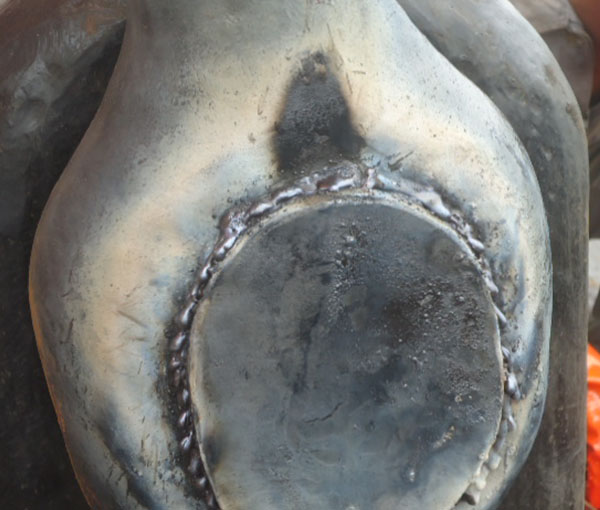
The crew found that there was a problem with the paint and did not properly treat the old coating. Simply deal with the old coating and paint directly. Not only did the problem not be resolved, but the solvent in the new paint followed the old coating. The cracks infiltrate the old coating and the steel surface, accelerating the shedding of the old coating. Such a paint coating seems to be too much to look at.
In the process of shipbuilding, people often pay little attention to the coating of the engine room, and do not soak in water or sunlight, thinking that there will be no trouble with the paint of the engine room. In fact, even if the engine room is polished, the surface treatment must be in place, and the dead corners must be treated in a way to eliminate hidden dangers.
2. The flaw detection fluid must be removed
This is a ship under construction that will be launched soon. After the rudder blade was sprayed with a primer, the paint was partially peeled off, and it was found that there was oil stains underneath with a spatula. It is not ordinary engine oil or oil stains with a hand. The preliminary judgment may be a flaw detection fluid with strong penetrating power.
But we can clearly see that even after the sand washing treatment, the flaw detection fluid gradually penetrates the paint surface to form oil droplets. In this case, you must replace the fine sand and flush the sand again to wash out all the problematic paint.
All the paint contaminated by the flaw detection fluid was sanded three times to remove all the flaw detection fluid that has been immersed in the surface roughness of the steel plate.
Through this extreme case, everyone must pay attention to the flaw detection fluid. If you encounter obvious flaw detection fluid retention, you must repeat the sanding treatment and cannot be polished by hand. Manual polishing can only remove the flaw detection fluid on the surface, and cannot be cleaned with thinner. Because the penetration of the flaw detection fluid is very strong, it has penetrated into the weld. The flaw detection fluid in the depression or the roughness of the steel surface cannot be washed away, and it will slowly leak out from the depression or roughness, causing the paint to peel off.
3. Excessive humidity
This is that the paint on the radar mast part of the ship has not been installed on the ship. The two-degree epoxy primer and one-degree polyurethane topcoat, but there is poor adhesion between the topcoat and the second-degree epoxy, and paint appears. Shedding phenomenon.
The painter went to repair the topcoat immediately after the rain stopped. When the topcoat was overcoated, the mist had just begun to dissipate, and the relative humidity had just reached 85 percent. The surface of the primer is saturated with water. Although the humidity is just critical, there are still many parts on the surface of the primer that the water vapor has not dissipated, and there is a water film invisible to the naked eye on the surface of the coating. It is not surprising that the paint is peeling off. Therefore, after the rain, snow, and foggy days, it is necessary to ensure that the surface of the steel plate has sufficient time to dry to remove water vapor. If you can avoid the critical point of relative humidity, paint should be avoided as much as possible.
3. Mixed use of summer type and winter type paint
For a new ship, one voyage, the crew suddenly discovered that the cargo oil pump was overloaded when unloading the cargo, and the amount of oil in the pipeline could not even reach half of the design standard. After disassembling the pipeline, it was found that a large number of paint fragments blocked the filter of the oil unloading valve, causing pieces of paint in the cargo hold to fall off, making it impossible to use it again.
The cargo tanks of the entire ship except for the earliest one (the summer type of primer and topcoat used), the paint and coatings of the other tanks were all scrapped, the new ship was forced to suspend, and the empty ship from abroad returned to China. Remove all paint and repaint. Fortunately, the coating of one of the cabins was intact, or the reason for the failure of the coating is really hard to find. Because everyone attaches great importance to the special coating cabin, the construction process is carried out under strict quality control by paint dealers, shipowners and shipyards. The records are complete and fully meet the special coating construction process requirements. Only the primer is summer type, and the top coat As it enters the winter season, the winter type is used instead.
The economic loss of this accident was very large, and the lesson was so painful. Why is it that when we are about to enter the winter, when we are ready to change to winter-type paint, we will find painters constantly instructing that summer and winter paint should be separated and not mixed. Although the main film-forming materials of summer and winter paints are the same, but the drier, thickener, curing agent, toluene, xylene, acetone, butyl acetate, ethyl acetate, chlorobenzene, turpentine, etc. assist in film-forming The chemical composition ratios of substances and solvents are completely different. If mixed, the adhesion between the coatings will be greatly reduced, extreme or even incompatibility, the risk of paint peeling is great.
Therefore, I remind everyone to remember: summer paint and winter paint must be separated and never mixed!
5. Recoating interval is overdue
The ship has just left the factory for two months, and the adhesion between the freeboard finish and the second degree epoxy is not good, and the paint peels off. After checking the construction records, it was found that the topcoat was sprayed on the same day and exceeded the recoating interval. This is the reason that the topcoat has insufficient adhesion and the paint will fall off as soon as it receives external force.
Everyone must read the paint instructions carefully during the usual painting construction. Master the recoating interval of all paints, arrange the production sequence reasonably, and complete the entire coating work within the recoating interval as much as possible, especially the shortest recoating interval for the primer and topcoat, and apply immediately after the recoating interval is over. Top coat, so that the primer and top coat can be mutually soluble, and the adhesion between layers is effective.


: failed to open stream: Permission denied in /home/pcshiprepairxp0ccszhpigper7ecpnaiizr/wwwroot/en/source/core/class.mysqli.php on line 63
http://www.pc-shiprepair.com/en/data/upload/202103/20210301102113_298.jpg)
: failed to open stream: Permission denied in /home/pcshiprepairxp0ccszhpigper7ecpnaiizr/wwwroot/en/source/core/class.mysqli.php on line 63
http://www.pc-shiprepair.com/en/data/upload/202102/20210226084008_962.png)